
Improving AI Visibility with Adobe's LLM Optimizer
December 8, 2025
In today’s world, visibility isn’t just about people seeing your content; it’s about how well an LLM is able to view it. When someone uses any sort of LLM to ask a question the answer will usually be accompanied by a number of citations. Having your content frequently cited can be the difference in thousands of views and potential customers. Until now, understanding how crawlable your content is felt like mostly smoke and mirrors, but now Adobe has created a solution for this. Adobe LLM Optimizer (LLMO) is a tool that breaks down when, where, and how your content is shown across platforms and can even compare it to competitors' content.
Introducing to Adobe LLM Optimizer
What Can LLMO Do for You?
Adobe’s LLM Optimizer gives you a clear view of how your brand shows up across AI-powered search. You can track when and where AI mentions you with a visibility score you can actually benchmark over time, see how you stack up against competitors inside generative engines, and spot real share-of-voice gaps. It also surfaces actionable opportunities, from content fixes like FAQs and schema to technical issues like crawlability, all tied directly to boosting citations. On top of that, you can measure the actual impact by monitoring traffic coming from AI assistants and clicks from AI-generated citations. And to keep everyone aligned, teams can share dashboards, assign owners, and track visibility goals across SEO, marketing, and comms in one place.
Why should you use it?
LLMs are now a primary starting point for users who want quick answers, product comparisons, instructions, or general research. Many people skip the search engine entirely and go straight to tools like ChatGPT, Perplexity, or AI-enhanced Google results. This shift means that even well-optimized websites can lose visibility if they are not structured in a way AI systems can interpret.
A site can be fast, mobile-friendly, and technically solid, but still fail to show up in AI-generated answers. When this happens, your content becomes invisible at the exact moment users are searching for solutions. The risk is not just lower traffic. You also lose topical authority, brand presence, and the chance to influence a user’s decision during early research.
LLMO helps prevent that by revealing how AI agents see your site. Most teams have no way of knowing whether an LLM can read their content, understand it, or treat it as a reliable source. LLMO fills that gap by showing crawlability, readability, and citation patterns that would otherwise be impossible to detect. If an AI system is skipping your content, you will see it. If your content is being pulled in as a potential source but not cited, you will see that too.
This makes the tool valuable for more than SEO. It helps marketing, content strategy, product teams, and communication teams understand how their work appears inside the AI ecosystem. Instead of guessing, you can make targeted improvements that directly increase citations and visibility.
The benefit is simple. If more AI systems can successfully read and reference your content, you have a better chance of appearing in answers that users rely on every day. The outcome is more exposure, more traffic, and more opportunities for your brand to show up where users are searching.
Overview of Tools
Market Comparison
This gives you an overview of how your content is performing compared to other companies (of your choosing). Your visibility is given a percentage scored based on a weighted measure that combines mentions, citations, position, and sentiment and can be a good idea of the impact your brand is having overall.
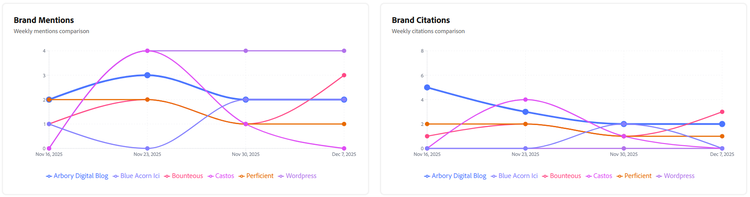
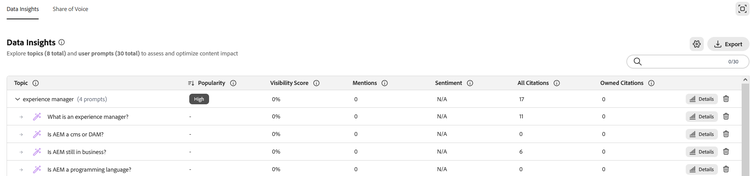
The tool also highlights high-interest topics and suggests areas where new or updated content may help.
Agentic Traffic
This is one of the most important views because it measures and monitors the interactions and patterns of AI traffic. It provides an overview of how many times your site has been requested by all non-human traffic along with the success rate and time to first byte (TTFB). It also provides a readability score that reflects how well an LLM can parse your content. This can reveal issues like heavy JavaScript that slows down or prevents crawling.
After you’ve trudged through all of this information you can see a breakdown of your websites traffic across multiple metrics. This is a good way of knowing what countries your content is performing well in, which is especially helpful if you want to break into foreign markets. The Response Code Breakdown provides insight into errors that may be affecting crawlability.
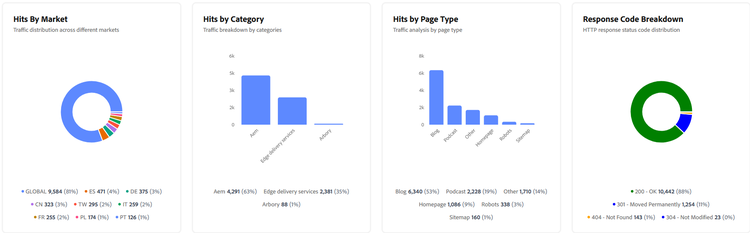
A deeper breakdown shows which pages within your domain are gaining or losing visibility each week and which types of AI agents are accessing them.

Referrals
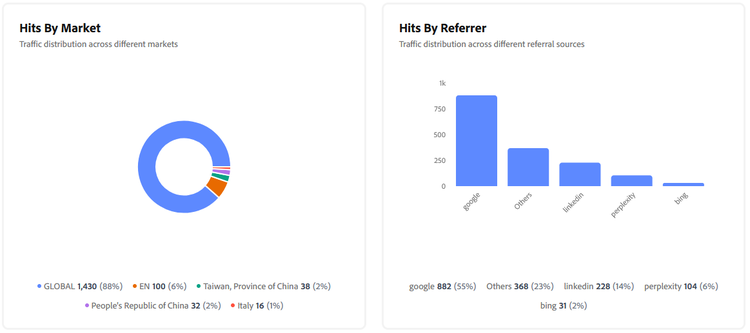
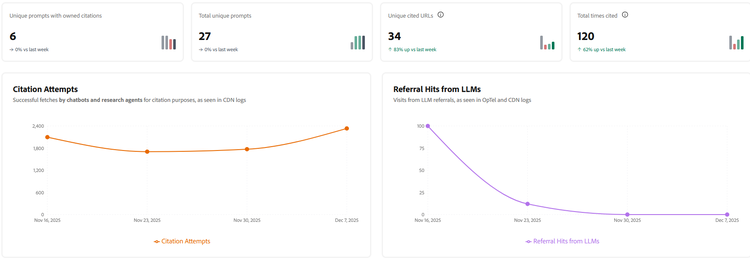
Your content being cited by AI is all well and good but at the end of the day the important part is the end user navigating to your site. Referral traffic shows you exactly this broken down by search method and regions. This can give you a better idea of where your content is performing well whether it be Google, LinkedIn, Perplexity, etc.
URL Inspector
When an AI chatbot or research agent is searching for information, they tend to group many pages as potential sources to be cited. These are called citation attempts and even if your page is not used as a final source, it is an important metric of visibility. Comparing citation attempts to referral traffic can tell you how effective the citations are at generating real user visits to your content.
Opportunities
Everything above describes performance metrics. Opportunities focuses on what you can change. Knowing how to optimize an LLM can be a confusing and tedious task. Luckily we’ve been talking about doing that this entire time. The LLMO is able to give recommendations for content and technical optimizations. This gives suggestions that only affect AI agents to ensure that the experience remains the same for human users, and optimizations that don’t touch the CMS or change any code. There are a number of different changes that the system will recommend. One of these are content summarizations on high traffic pages that can improve discoverability as full-page or section specific summaries. Technical optimizations can show you what pages return a 404 and how many hits you are losing to these. Sometimes there are visibility issues with certain pages that can be the result of any number of reasons. We can use this tool to see what percentage of the content is readable by AI, potential fixes, and actions you can take to make it more readable.
Adobe LLM Optimizer Chrome Extension
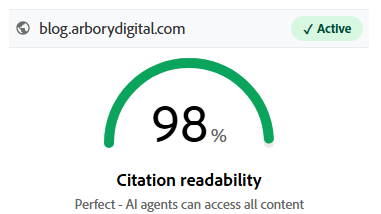
LLMO is able to give you a great overview with bits of direct URL viewing, but sometimes the ability to rapidly check specific pages can be not only useful but more efficient. To that end, Adobe has created a chrome extension to do exactly this. The LLM Optimizer Chrome Extension is a tool that first displays a simplified view of how citable/readable a page is to a LLM. Once you've seen this score, there is an option to view a much more detailed breakdown of how that score was calculated and ways you can improve it. I would highly recommend taking a look at this extension if you are serious about LLM visibility.
Conclusion
AI-driven search is becoming a major gateway for how people discover information, and brands need to have an understanding of how they work. Adobe LLM Optimizer gives you visibility into how AI systems interpret your content in a way that has traditionally been unavailable. If AI visibility is treated with even a fraction of the attention SEO is given, brand growth is nearly guaranteed. With each day it seems that AI is here to stay and it would be a fool’s errand to not give it at least some work.
About the Author

Noah Mattison
Technical Delivery Manager at Arbory Digital
Noah is a Computer Science graduate from UNC Wilmington, originally a pre-med student with a passion for cancer detection and AI. At Arbory, he helps plan project execution, delegates work across teams, maintains strong communication, and supports internal operations. He believes in Arbory’s community and vision. He is environmentally focused and enjoys staying active outdoors, camping, rock climbing, and spending time with friends.
Like what you heard? Have questions about what’s right for you? We’d love to talk! Contact Us

